


Page 30 - Demo
P. 30
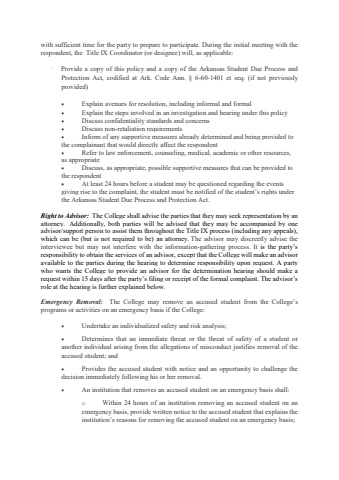
with sufficient time for the party to prepare to participate. During the initial meeting with the respondent, the Title IX Coordinator (or designee) will, as applicable: %u00b7 Provide a copy of this policy and a copy of the Arkansas Student Due Process and Protection Act, codified at Ark. Code Ann. %u00a7 6-60-1401 et seq. (if not previously provided) %u2022Explain avenues for resolution, including informal and formal %u2022Explain the steps involved in an investigation and hearing under this policy %u2022Discuss confidentiality standards and concerns %u2022Discuss non-retaliation requirements%u2022Inform of any supportive measures already determined and being provided to the complainant that would directly affect the respondent %u2022Refer to law enforcement, counseling, medical, academic or other resources, as appropriate %u2022Discuss, as appropriate, possible supportive measures that can be provided to the respondent %u2022At least 24 hours before a student may be questioned regarding the events giving rise to the complaint, the student must be notified of the student%u2019s rights under the Arkansas Student Due Process and Protection Act. Right to Advisor:The College shall advise the parties that they may seek representation by an attorney. Additionally, both parties will be advised that they may be accompanied by one advisor/support person to assist them throughout the Title IX process (including any appeals), which can be (but is not required to be) an attorney.The advisor may discreetly advise the interviewee but may not interfere with the information-gathering process. It is the party%u2019s responsibility to obtain the services of an advisor, except that the College will make an advisor available to the parties during the hearing to determine responsibility upon request. A party who wants the College to provide an advisor for the determination hearing should make a request within 15 days after the party%u2019s filing or receipt of the formal complaint. The advisor%u2019s role at the hearing is further explained below.Emergency Removal:The College may remove an accused student from the College%u2019s programs or activities on an emergency basis if the College: %u2022Undertake an individualized safety and risk analysis; %u2022Determines that an immediate threat or the threat of safety of a student or another individual arising from the allegations of misconduct justifies removal of the accused student; and%u2022Provides the accused student with notice and an opportunity to challenge the decision immediately following his or her removal.%u2022An institution that removes an accused student on an emergency basis shall:oWithin 24 hours of an institution removing an accused student on an emergency basis, provide written notice to the accused student that explains the institution%u2019s reasons for removing the accused student on an emergency basis;


