


Page 12 - Demo
P. 12
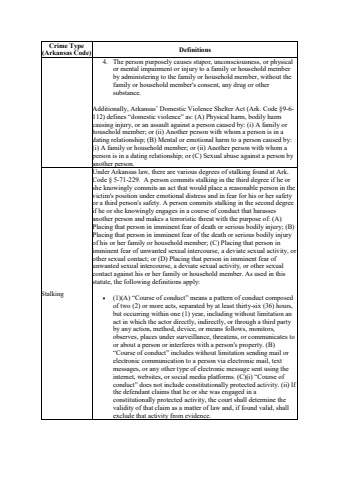
Crime Type (Arkansas Code)Definitions4.The person purposely causes stupor, unconsciousness, or physical or mental impairment or injury to a family or household member by administering to the family or household member, without the family or household member's consent, any drug or other substance.Additionally, Arkansas%u2019 Domestic Violence Shelter Act (Ark. Code %u00a79-6-112) defines %u201cdomestic violence%u201d as: (A) Physical harm, bodily harm causing injury, or an assault against a person caused by: (i) A family or household member; or (ii) Another person with whom a person is in a dating relationship; (B) Mental or emotional harm to a person caused by: (i) A family or household member; or (ii) Another person with whom a person is in a dating relationship; or (C) Sexual abuse against a person by another person.StalkingUnder Arkansas law, there are various degrees of stalking found at Ark. Code %u00a7 5-71-229. A person commits stalking in the third degree if he or she knowingly commits an act that would place a reasonable person in the victim's position under emotional distress and in fear for his or her safety or a third person's safety. A person commits stalking in the second degree if he or she knowingly engages in a course of conduct that harasses another person and makes a terroristic threat with the purpose of: (A) Placing that person in imminent fear of death or serious bodily injury; (B) Placing that person in imminent fear of the death or serious bodily injury of his or her family or household member; (C) Placing that person in imminent fear of unwanted sexual intercourse, a deviate sexual activity, or other sexual contact; or (D) Placing that person in imminent fear of unwanted sexual intercourse, a deviate sexual activity, or other sexual contact against his or her family or household member. As used in this statute, the following definitions apply:%u2022(1)(A) %u201cCourse of conduct%u201d means a pattern of conduct composed of two (2) or more acts, separated by at least thirty-six (36) hours, but occurring within one (1) year, including without limitation an act in which the actor directly, indirectly, or through a third party by any action, method, device, or means follows, monitors,observes, places under surveillance, threatens, or communicates to or about a person or interferes with a person's property. (B) %u201cCourse of conduct%u201d includes without limitation sending mail or electronic communication to a person via electronic mail, textmessages, or any other type of electronic message sent using the internet, websites, or social media platforms. (C)(i) %u201cCourse of conduct%u201d does not include constitutionally protected activity. (ii) If the defendant claims that he or she was engaged in a constitutionally protected activity, the court shall determine the validity of that claim as a matter of law and, if found valid, shall exclude that activity from evidence.


