


Page 16 - Demo
P. 16
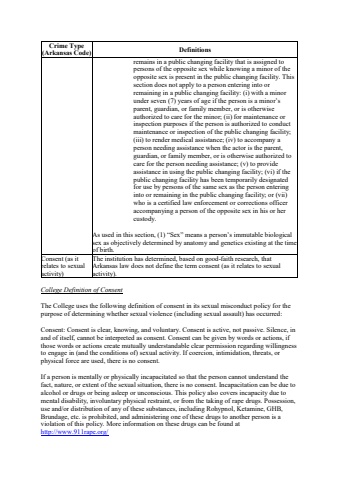
Crime Type (Arkansas Code)Definitionsremains in a public changing facility that is assigned to persons of the opposite sex while knowing a minor of the opposite sex is present in the public changing facility. This section does not apply to a person entering into or remaining in a public changing facility: (i) with a minor under seven (7) years of age if the person is a minor%u2019s parent, guardian, or family member, or is otherwise authorized to care for the minor; (ii) for maintenance or inspection purposes if the person is authorized to conduct maintenance or inspection of the public changing facility; (iii) to render medical assistance; (iv) to accompany a person needing assistance when the actor is the parent, guardian, or family member, or is otherwise authorized to care for the person needing assistance; (v) to provide assistance in using the public changing facility; (vi) if the public changing facility has been temporarily designated for use by persons of the same sex as the person entering into or remaining in the public changing facility; or (vii) who is a certified law enforcement or corrections officer accompanying a person of the opposite sex in his or her custody. As used in this section, (1) %u201cSex%u201d means a person%u2019s immutable biological sex as objectively determined by anatomy and genetics existing at the time of birth.Consent (as it relates to sexual activity) The institution has determined, based on good-faith research, that Arkansas law does not define the term consent (as it relates to sexual activity).College Definition of ConsentThe College uses the following definition of consent in its sexual misconduct policy for the purpose of determining whether sexual violence (including sexual assault) has occurred: Consent: Consent is clear, knowing, and voluntary. Consent is active, not passive. Silence, in and of itself, cannot be interpreted as consent. Consent can be given by words or actions, if those words or actions create mutually understandable clear permission regarding willingness to engage in (and the conditions of) sexual activity. If coercion, intimidation, threats, or physical force are used, there is no consent. If a person is mentally or physically incapacitated so that the person cannot understand the fact, nature, or extent of the sexual situation, there is no consent. Incapacitation can be due to alcohol or drugs or being asleep or unconscious. This policy also covers incapacity due to mental disability, involuntary physical restraint, or from the taking of rape drugs. Possession, use and/or distribution of any of these substances, including Rohypnol, Ketamine, GHB, Brundage, etc. is prohibited, and administering one of these drugs to another person is a violation of this policy. More information on these drugs can be found at http://www.911rape.org/


